
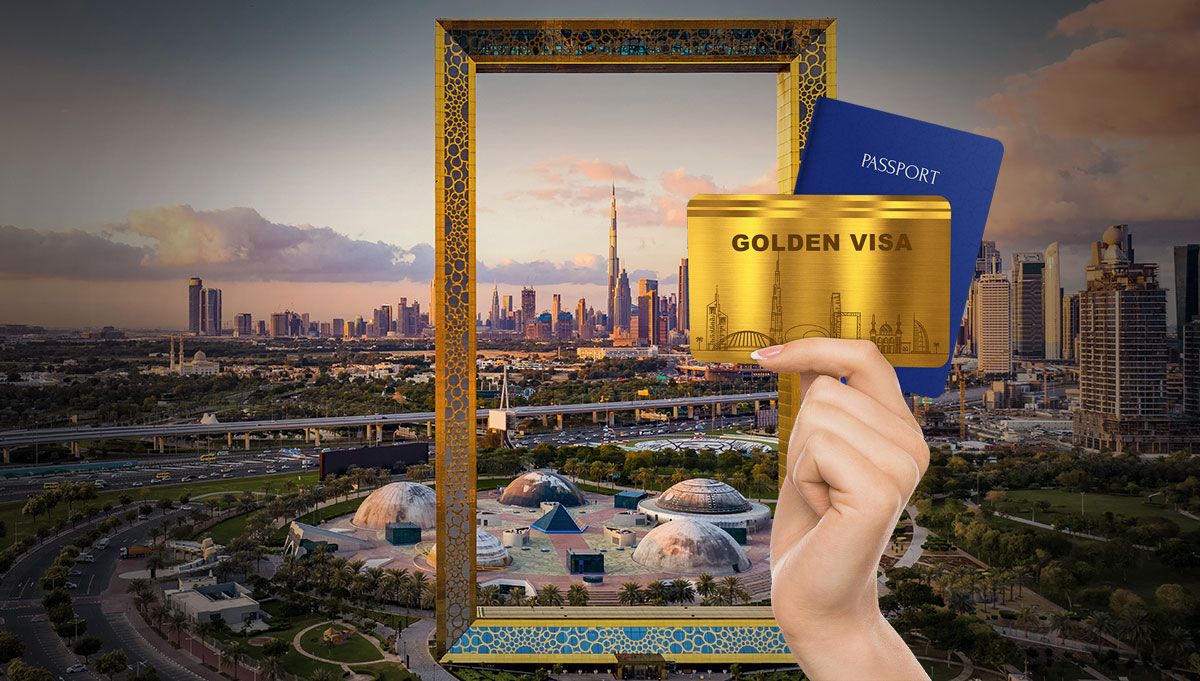

The UAE Golden Visa is a long-term residency program designed to attract investors, professionals, and global talent. For property investors, it offers a 10-year renewable residency without the need for a local sponsor, provided the investor owns qualifying real estate in the UAE. More importantly, the visa allows holders to sponsor their spouse, children, and even parents, creating long-term stability for families.
Beyond residency, the program delivers tangible lifestyle and financial benefits: a tax-free environment, world-class infrastructure, and enhanced government support both inside and outside the country. In this article, we will walk you through the latest Golden Visa Property Updates, explore how the UAE real estate market is evolving in 2026, and finally compare the UAE’s Golden Visa with recent changes across key European programs, so you can clearly see where real value lies.
As of February 2026, property investors remain eligible for the UAE Golden Visa by maintaining real estate assets valued at AED 2 million or more. This threshold can be met through a single property, multiple units, or even approved off-plan projects, offering flexibility rarely seen elsewhere.
What stands out in current UAE property news is the government’s commitment to continuity. While many global residency-by-investment schemes are being revised or restricted, the UAE has preserved a clear, predictable framework. Applications can be submitted via the Dubai Land Department or the ICP, with typical processing times of one to two months, which is efficient by international standards.
Rather than sharp price swings, 2026 is defined by moderation and balance. According to recent UAE Real Estate news, Dubai’s market is experiencing steady, sustainable growth, making it particularly appealing to long-term investors.
From a performance perspective, rental demand remains strong in prime areas, with yields typically ranging from 6% to 8%. These returns align closely with current Dubai real estate market trends, where end-users and long-term residents are increasingly driving demand instead of short-term speculation.
This shift toward value preservation and income stability also reflects broader UAE real estate market trends, positioning property ownership as both a lifestyle decision and a financial hedge.
What truly differentiates the UAE Golden Visa in 2026 is the expansion of benefits beyond immigration status. Visa holders now enjoy enhanced global and local support, including emergency assistance while traveling abroad. Plus:
Are other benefits of this visa.
These enhancements are part of a wider effort to anchor investors in the region, aligning the program with broader GCC real estate market trends that emphasize stability, livability, and long-term commitment.
Several reforms introduced in 2025 continue to influence the program’s structure in 2026. New eligibility categories such as philanthropic contributors, humanitarian pioneers, and creative professionals signal the UAE’s intent to diversify beyond traditional investment profiles.
At the same time, the Golden Visa Property Updates from this period confirmed something critical for investors: the AED 2 million property threshold remains firmly in place, reinforcing clarity and confidence. Market observers expect future refinements to focus on nomination processes and service expansion rather than tightening eligibility.
Several reforms introduced in 2025 continue to influence the program’s structure in 2026. New eligibility categories such as philanthropic contributors, humanitarian pioneers, and creative professionals signal the UAE’s intent to diversify beyond traditional investment profiles.
Across Europe, the landscape for property-based residency has changed dramatically. Portugal has eliminated real-estate eligibility. Spain has abolished its Golden Visa program. Greece still offers a pathway, but with sharply increased thresholds and strict limitations on qualifying properties.
This contrast is increasingly visible in every major UAE real estate market report. While Europe shifts toward fund-based or cultural investment routes, the UAE continues to recognize real estate as a cornerstone of long-term residency and economic growth. For investors seeking clarity, speed, and tangible asset-backed residency, the divergence is hard to ignore.
We have provided a Golden Visa Comparison in the table below:
| Country | Property Route Status | Minimum Investment | Residency Duration | Key Notes |
| UAE | Active & stable | AED 2 million (~US$545k) | 10 years, renewable | Family inclusion, no sponsor, strong investor support |
| Portugal | Removed | N/A | N/A | Property route closed since 2023 |
| Greece | Restricted | €400k–€800k | 5 years | Limited €250k option for conversions only |
| Spain | Abolished | N/A | N/A | Golden Visa ended April 2025 |
| Turkey | Active | US$400k | Renewable | Higher political and currency risk |
Conclusion
The UAE Golden Visa remains a 10-year, renewable residency option anchored in real estate investment, family security, and long-term value. The most recent Golden Visa Property Updates confirm market stability, consistent investment thresholds, and expanded benefits that go far beyond residency alone.
At a time when European programs are narrowing or disappearing, the UAE continues to refine, not restrict, its offerings. We hope this article has helped you better understand where the real opportunities lie and why, for many global investors, the UAE Golden Visa truly feels like 24-carat gold.